Vehicle recovery equipment is defined as the specialized tools and machinery used to extract, stabilize, and transport disabled or stuck vehicles safely. The most common types of vehicle recovery equipment include winches, kinetic recovery straps, shackles, snatch blocks, boom trucks, and flatbed trailers. Each tool addresses a different recovery challenge, from a sedan stuck in a ditch to a semi-truck overturned on a highway. Knowing which gear fits which situation is the difference between a clean extraction and a costly mistake.
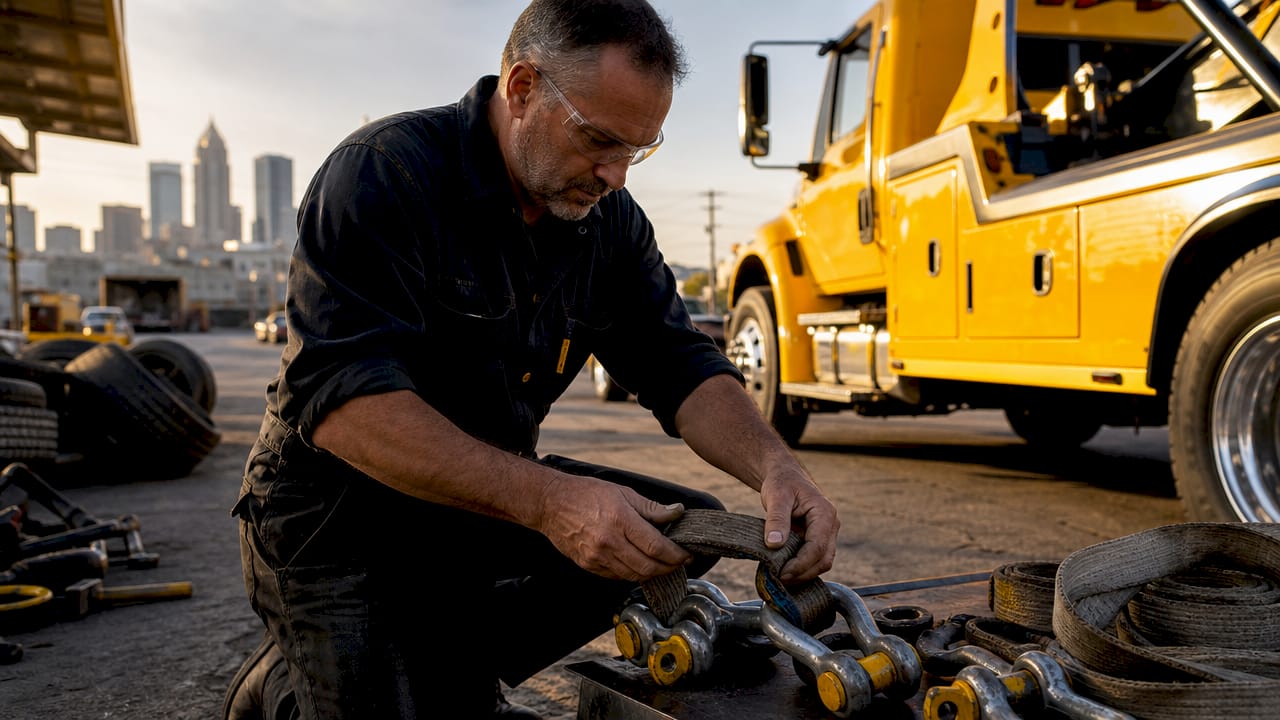
1. Types of vehicle recovery equipment: the core toolkit
Every recovery starts with the right foundation. These are the tools you will find on professional rigs and in well-prepared off-road kits alike.
- Winches and winch ropes. A winch uses a motorized drum to pull a vehicle out of mud, sand, or a ditch. Synthetic winch ropes are now preferred over steel cable because they are lighter, safer to handle, and do not store dangerous energy when under tension.
- Kinetic recovery straps (snatch straps). Kinetic straps stretch under load to absorb shock and generate a smooth pulling force, unlike static tow straps that transfer force instantly and risk snap-back injuries. Use kinetic straps for vehicle-to-vehicle recoveries on soft terrain.
- Snatch blocks and pulley systems. A snatch block is a pulley that redirects a winch line or doubles its pulling power. Rigging a snatch block correctly can double your winch’s effective capacity without upgrading the winch itself.
- Tree saver straps and extension straps. Tree saver straps wrap around anchor points like trees to protect bark and distribute load. Extension straps add reach when the winch line falls short of a solid anchor.
- Soft shackles vs. steel shackles. Soft shackles made of synthetic rope are safer and lighter than steel shackles. If a soft shackle fails under load, it drops to the ground instead of becoming a projectile.
Pro Tip: Always match your recovery gear rating to at least 1.5 times your vehicle’s gross weight. Undersized equipment fails under the dynamic loads of a real recovery.
2. How heavy-duty and specialized recovery equipment differs
Standard gear handles passenger cars and light trucks. Heavy-duty scenarios require a completely different class of equipment with higher load ratings and hydraulic power.
- Rotator wreckers. A rotator wrecker features a 360-degree rotating boom that can pull from any angle. This makes rotators the go-to tool for overturned semis, vehicles pinned against barriers, and complex accident scenes where a straight pull is impossible.
- Integrated wreckers. These combine a heavy-duty boom, underlift, and wheel-lift into one unit. They handle straight pulls on large trucks and buses efficiently, and professional services using them typically charge $300 to $1,000 or more per recovery.
- Boom trucks. Boom trucks excel at extracting vehicles from ditches, embankments, and off-road terrain where a flatbed cannot reach. Their hydraulic arms extend and articulate to reach vehicles in positions no other truck can access.
- Landoll and lowboy trailers. These trailers transport disabled heavy vehicles like construction equipment or large commercial trucks. A Landoll trailer’s tilting deck slides to ground level for easy loading without a ramp.
- High-strength kinetic ropes and heavy-duty soft shackles. For serious off-road recovery, kinetic ropes rated at 30,000 lbs or more and soft shackles with matching break strengths are the industry standard. These tools absorb energy that would otherwise snap a standard strap or damage a recovery point.
- Hydraulic outriggers and stabilizers. PTO hydraulic systems power the lifting, pulling, and load-holding functions on heavy wreckers, while outriggers prevent the truck from tipping during extreme pulls.
Pro Tip: If a vehicle weighs more than 10,000 lbs or is in an off-angle position, call a rotator or integrated wrecker. Using a standard wheel-lift on a heavy truck in a ditch risks secondary damage to both vehicles.
3. Comparing recovery equipment types side by side
Choosing the right tool comes down to vehicle type, terrain, and the severity of the situation. This table gives you a fast reference.
| Equipment | Best use case | Load capacity | Key limitation |
|---|---|---|---|
| Kinetic recovery strap | Vehicle-to-vehicle soft terrain pull | Up to 30,000 lbs (rated) | Requires a second vehicle as anchor |
| Winch with synthetic rope | Self-recovery or assisted extraction | Varies by model (8,000–20,000 lbs typical) | Needs a solid anchor point nearby |
| Soft shackle | Connecting straps and winch lines | 30,000+ lbs | Not for use with steel hooks directly |
| Wheel-lift tow truck | Quick urban pickups | Light to mid-size vehicles | Cannot safely transport AWD or damaged drivetrains |
| Flatbed tow truck | Transporting damaged or AWD vehicles | Most passenger vehicles | Cannot extract vehicles from inaccessible terrain |
| Boom truck | Off-road and ditch extractions | Medium to heavy vehicles | Higher cost; overkill for simple roadside tows |
| Rotator wrecker | Complex accident and off-angle recovery | Heavy commercial vehicles | Most expensive option; $300–$1,000+ per use |
Cost is a real factor when you call a professional service. Towing costs range from $75 for a basic wheel-lift to over $1,000 for a heavy-duty integrated wrecker recovery. The equipment required by the situation drives that price, not the service provider’s preference.
One scenario worth noting: hook-and-chain wreckers are declining in professional use because they cause frame and body damage. Flatbeds and wheel-lifts have replaced them for most passenger vehicle recoveries.
4. Safety best practices when using vehicle recovery gear
Recovery gear used incorrectly causes injuries and vehicle damage. These practices are non-negotiable.
- Use rated recovery points. Tow balls and trailer hitches are not recovery points. Always attach straps and shackles to manufacturer-designated recovery hooks or D-rings rated for the load.
- Understand kinetic energy in straps. Kinetic straps absorb shock by stretching, which reduces peak force on both vehicles. Static straps transfer the full force instantly, which can snap recovery points or cause violent snap-back.
- Use a winch damper. Drape a heavy blanket or purpose-built winch damper over the winch line during a pull. If the line snaps, the damper absorbs energy and drops the line instead of letting it whip back.
- Protect your anchor with a tree saver strap. Wrapping a winch line directly around a tree damages the bark and concentrates stress on a small area. A tree saver strap distributes the load and protects the anchor.
- Never stand in the “kill zone.” The kill zone is the area directly in line with a tensioned strap or winch rope. If the line or connection fails, it travels in a straight line at high speed. Stand to the side, behind cover when possible.
- Inspect gear before every use. Check straps for fraying, shackles for cracks, and winch ropes for kinks or broken strands. A compromised strap can fail at a fraction of its rated load.
Pro Tip: Store your recovery kit in a dedicated bag with a checklist. Gear that is tangled, dirty, or missing a shackle is useless when you need it most. Check the kit every six months even if you have not used it.
5. Matching recovery equipment to your situation
Not every driver or business needs the same kit. Here is how to think about it based on your role.
For individual drivers and off-road enthusiasts:
- A kinetic recovery strap (rated to at least 1.5x your vehicle’s weight), two soft shackles, a snatch block, and a tree saver strap cover most light-duty recoveries
- A portable electric winch mounted to your vehicle adds self-recovery capability when no second vehicle is available
- Traction boards like those tested for 10-ton compression provide grip on sand, mud, and snow without needing an anchor at all
- Gloves and a recovery damper complete a safe, portable kit that fits in a single bag
For roadside assistance businesses:
- High-capacity shackles, snatch blocks, and a wheel-lift or flatbed truck handle the majority of urban roadside calls
- A flatbed is the safest choice for transporting AWD vehicles and luxury cars without drivetrain damage
- A boom truck adds the ability to handle ditch extractions and off-road calls that a flatbed cannot reach
For heavy-duty fleet operators:
- Rotator wreckers and integrated wreckers are the core tools for commercial truck recovery
- Hydraulic boom systems, outriggers, and Landoll trailers round out a fleet capable of handling any scenario
- Investment in rated, modern gear pays for itself by preventing secondary damage claims and liability exposure
The balance between investment and reliability matters. Cheap, unrated gear fails at the worst possible moment. Spending more on certified equipment from reputable manufacturers protects your vehicle, your crew, and anyone nearby.
Key takeaways
The right vehicle recovery equipment matches the vehicle weight, terrain, and recovery angle. Using mismatched gear causes equipment failure, vehicle damage, and serious injury.
| Point | Details |
|---|---|
| Kinetic straps over static | Kinetic straps absorb shock and reduce snap-back risk; static straps do not stretch and can cause injury. |
| Match gear to vehicle weight | Always use equipment rated to at least 1.5 times the gross vehicle weight for safe recovery. |
| Rotators for complex recoveries | Rotator wreckers handle off-angle and over-barrier lifts that no other truck can safely perform. |
| Flatbeds protect drivetrains | Flatbed tow trucks are the safest transport option for AWD and damaged vehicles on open roads. |
| Inspect gear regularly | Check straps, shackles, and winch ropes every six months to catch wear before it causes a failure. |
What experience actually teaches you about recovery gear
After years of seeing recoveries go right and wrong, one pattern stands out clearly: people consistently underestimate the forces involved. A vehicle stuck in soft mud at 5,000 lbs does not require 5,000 lbs of pull force. Suction, angle, and momentum multiply that number fast. That is why rated gear and proper rigging matter more than raw power.
The other thing that surprises people is how much a snatch block changes the game. Doubling your mechanical advantage with a single pulley is one of the most underused techniques in light-duty recovery. Most drivers carry a winch but skip the snatch block, then wonder why the winch struggles on a moderate pull.
I have also seen the consequences of using a tow ball as a recovery point. The ball shears off under dynamic load and becomes a projectile. This is not a theoretical risk. It happens, and it causes serious injuries. Rated recovery points are not optional.
The shift from steel shackles to soft shackles is one of the best changes the industry has made. Soft shackles are genuinely safer, and there is no performance trade-off at the loads most drivers encounter. If your kit still has only steel shackles, swap at least one for a soft shackle rated to match your strap.
Finally, training matters. Reading about kinetic energy in recovery and actually practicing a recovery are two different things. Run a practice recovery in a safe environment before you need to do it under pressure. The gear only works as well as the person using it.
— Virtual
Get fast, professional recovery help in Wichita
When the situation is beyond your kit or your comfort level, Millerstowingict is ready around the clock.
Millerstowingict operates 24/7 emergency towing and vehicle recovery across Wichita, Kansas and surrounding communities. The fleet includes flatbed trucks, boom trucks, winch-equipped rigs, and heavy-duty wreckers, covering everything from a car in a ditch to a commercial vehicle accident. Every recovery uses rated, professional-grade equipment handled by trained operators. Whether you need a quick roadside assistance call or want to understand what a recovery will cost before you call, Millerstowingict gives you straight answers and fast response. Check the real cost of towing in Wichita before your next call so you know exactly what to expect.
FAQ
What is vehicle recovery equipment?
Vehicle recovery equipment is the collection of tools used to extract, stabilize, and transport disabled or stuck vehicles. Common examples include winches, kinetic recovery straps, shackles, snatch blocks, and boom trucks.
What is the difference between a kinetic strap and a tow strap?
A kinetic strap stretches under load to absorb shock and reduce peak force on both vehicles, while a static tow strap does not stretch and transfers force instantly, which risks snap-back injuries and recovery point failure.
When do you need a rotator wrecker instead of a standard tow truck?
A rotator wrecker is needed when a vehicle is overturned, pinned at an angle, or positioned where a straight pull is impossible. Its 360-degree rotating boom handles off-angle lifts that standard wheel-lift or flatbed trucks cannot perform safely.
How much does professional vehicle recovery cost?
Professional recovery costs range from $75 for a basic wheel-lift tow to over $1,000 for heavy-duty integrated wrecker service, depending on the equipment required and the complexity of the recovery scenario.
Are soft shackles as strong as steel shackles?
Yes. Soft shackles made from synthetic rope are rated at 30,000 lbs or more and match the strength of comparable steel shackles. Their key advantage is safety: a failed soft shackle drops to the ground instead of becoming a dangerous projectile.