
Long-distance towing is defined as the transport of a vehicle over distances typically exceeding 100 miles, requiring specialized equipment, experienced operators, and careful planning that short-range towing simply does not demand. The examples of long-distance towing needs span a wide range of situations, from a family relocating across state lines to a fleet manager repositioning Class 8 trucks across the country. Whether you are moving a classic car, recovering a broken-down semi, or transporting an electric vehicle to a distant dealership, the right towing method depends on your vehicle type, distance, and budget. Understanding these scenarios upfront helps you choose the safest and most cost-effective solution.
1. Personal vehicle relocation during a state-to-state move
Relocating across state lines is one of the most common reasons for long-distance vehicle transport. Many people moving from Kansas to Colorado or Texas to Illinois find that driving every vehicle in the household is impractical, especially when managing a moving truck, children, or pets at the same time.
- A family with two cars and a motorcycle can ship all three on a multi-car carrier rather than making multiple trips.
- Drivers with medical conditions or those moving solo often cannot safely drive long distances.
- Shipping a vehicle protects it from highway wear, weather exposure, and the risk of a breakdown far from home.
Long-distance towing services handle these moves regularly, and booking in advance reduces both cost and scheduling stress.
Pro Tip: Plan your long-distance tow at least one to two weeks ahead. Advance planning improves logistics, cost management, and reduces the risk of delays or damage.
2. Buying or selling a vehicle out of state
Purchasing a vehicle from a private seller or dealer in another state is a growing trend, especially with online marketplaces like Carvana, CarGurus, and Facebook Marketplace expanding the buyer’s geographic reach. The problem is that the vehicle may not be in drivable condition, or you simply do not want to add hundreds of miles to a car you just bought.
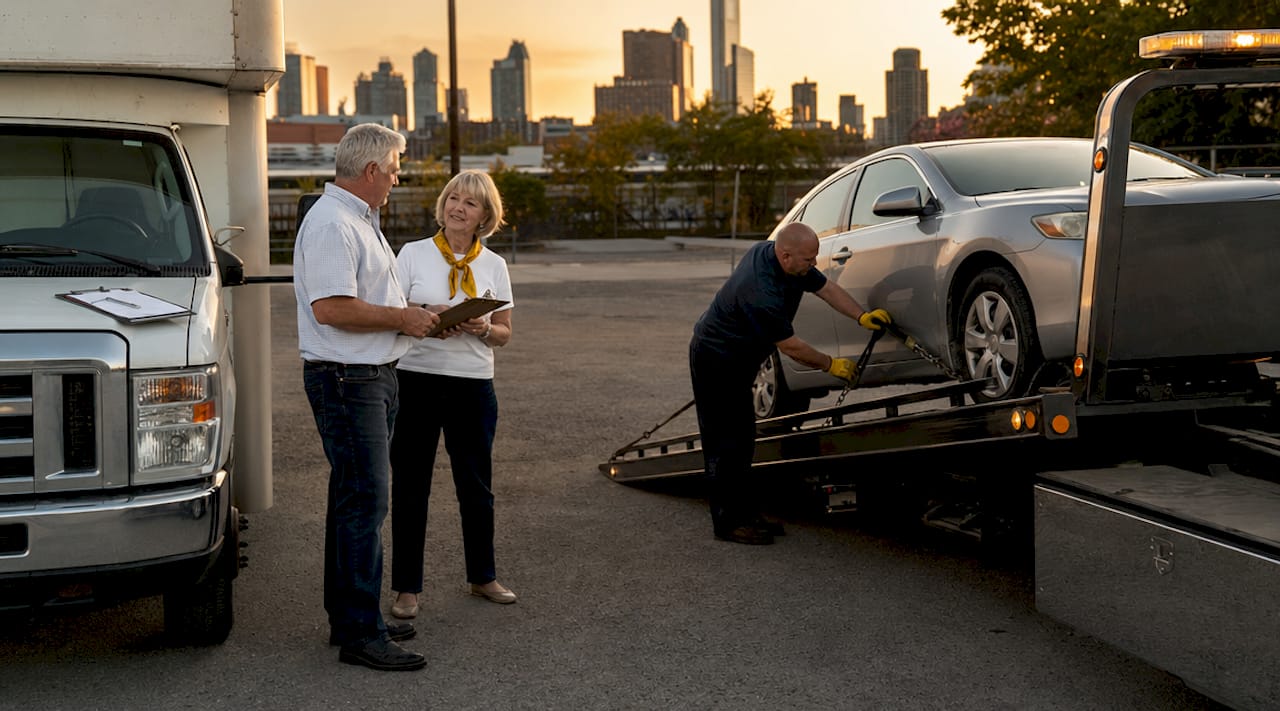
Sellers also face this situation. A classic Mustang listed on Bring a Trailer might attract a buyer in New York while the car sits in Wichita. Arranging transport is part of closing the deal. In both cases, a flatbed carrier is the standard choice because it keeps all four wheels off the road and prevents unnecessary wear on a vehicle that has not yet been inspected by the new owner.
3. Transporting electric vehicles over long distances
Electric vehicles present a unique towing challenge that most drivers do not anticipate. EVs cannot be flat towed with their wheels rolling on the ground without risking serious drivetrain damage or voiding the manufacturer’s warranty. This applies to popular models like the Tesla Model 3, Ford F-150 Lightning, and Rivian R1T.
Tow dollies, which lift only two wheels off the ground, are generally unsuitable for EVs unless the manufacturer explicitly permits it. A full flatbed is the only safe option for most electric vehicles. This single requirement changes the cost and equipment calculus for any EV owner planning a long-distance move or sending a vehicle to a distant service center.
Pro Tip: Always check your EV owner’s manual before booking transport. Some manufacturers void the warranty if the vehicle is towed incorrectly, even once.
4. Classic, luxury, and exotic car transport
A 1969 Camaro or a Lamborghini Huracán requires more than a standard flatbed. Enclosed trailers shield high-value vehicles from road debris, weather, and UV exposure during long-distance hauls. Open carriers are cheaper, but the risk of a stone chip or hail damage on a $200,000 exotic is not a trade-off most owners accept.
Enclosed transport costs more, but it delivers the vehicle in the same condition it left in. Auction houses like Barrett-Jackson and RM Sotheby’s routinely coordinate enclosed transport for vehicles crossing the country after a sale. If your vehicle has sentimental or significant monetary value, enclosed is the right call.
5. Towing a non-drivable vehicle to a distant repair facility
Sometimes the nearest qualified repair shop for your vehicle is not in your city. Owners of rare European imports, specialty diesel trucks, or performance vehicles often need to transport a non-running car to a dealership or specialist mechanic located hundreds of miles away. This is a direct example of a long-distance towing need driven by repair logistics rather than relocation.
Professional carriers use heavy-duty flatbeds and proper securing equipment to move non-drivable vehicles safely. Attempting to tow a non-running AWD vehicle with a wheel-lift truck risks transmission and axle damage. Flatbed is the only safe method here, and verifying that the towing company has experience with your specific vehicle type matters.
6. Commercial truck and fleet repositioning
Businesses that operate fleets of semi-trucks, delivery vans, or service vehicles regularly need to reposition assets across regions. A logistics company closing a terminal in Oklahoma City and opening one in Memphis needs to move 20 trucks efficiently. This is where driveaway services become a cost-effective alternative to flatbed towing. Driveaway providers send licensed drivers to physically drive Class 6 through 8 trucks to their new location, covering routes across the U.S. and Canada.
For trucks that are not drivable, heavy-duty towing is the answer. Heavy-duty towing for Class 6 to 8 trucks can cost $400 to $1,500 or more for under 25 miles, with per-mile rates between $7 and $15 for longer hauls. A 50-mile tow for a 35,000-pound dump truck can reach $1,000 to $1,600 including hookup and winch-out fees. That cost scales significantly over hundreds of miles, which is why fleet managers weigh driveaway options carefully for long-distance fleet moves.
7. Transporting construction equipment and oversized loads
Construction companies frequently need to move excavators, bulldozers, skid steers, and cranes between job sites located in different states. These loads require lowboy trailers, rotator trucks, and in some cases, state-issued oversize load permits. A standard flatbed cannot handle a 60,000-pound excavator. This is a specialized segment of long-distance towing that demands both the right equipment and operators with commercial towing credentials.
The planning involved is substantial. Oversize loads require route surveys, pilot cars, and sometimes coordination with state DOT offices. Businesses that skip this planning face fines, delays, and safety risks on the highway.
8. Emergency recovery of commercial vehicles after a breakdown or accident
A semi-truck that breaks down on I-70 between Wichita and Kansas City creates an immediate long-distance recovery need. The driver cannot simply wait for a local shop. The cargo may be time-sensitive, and the truck may need to be towed to a certified Freightliner or Peterbilt dealer that is not nearby. Surcharges apply for after-hours service, difficult rescues, and complex recoveries. Night and weekend surcharges can reach 40%, and winching fees add to the total when a truck has left the roadway.
Having a towing provider on speed dial who handles emergency roadside situations for commercial vehicles is not optional for fleet operators. It is a basic operational requirement.
9. How vehicle type changes your towing method
The table below shows how towing requirements shift based on vehicle type, which directly affects your cost and equipment choices.
| Vehicle type | Recommended method | Key reason |
|---|---|---|
| Standard sedan or SUV | Open flatbed | Cost-effective, safe for most conditions |
| AWD or 4WD vehicle | Flatbed only | Rolling-wheel tow risks transfer case damage |
| Electric vehicle | Flatbed only | All wheels must stay off the ground |
| Classic or exotic car | Enclosed trailer | Protection from debris, weather, and UV |
| Class 6 to 8 truck | Heavy-duty flatbed or driveaway | Weight and size exceed standard tow capacity |
| Construction equipment | Lowboy or rotator | Oversized load requirements and weight limits |
Pro Tip: If your vehicle is AWD or 4WD, always confirm with the towing company that they will use a flatbed. A wheel-lift tow truck on an AWD vehicle can cause thousands of dollars in drivetrain damage.
10. What long-distance towing actually costs
Long-distance towing costs range from $400 to $2,200 or more depending on distance, vehicle type, and service level. Here is a practical breakdown:
- In-state moves of 100 to 300 miles typically run $300 to $800 for a standard vehicle.
- Regional hauls of 300 to 800 miles average $600 to $1,200.
- Cross-country moves over 800 miles start at $900 and can exceed $2,200 for specialty vehicles.
- Enclosed trailer service adds a premium above open carrier rates.
Several factors push costs higher. After-hours calls, difficult pickup locations, multi-vehicle hauls, and accident recovery all add fees. You can review Wichita towing cost details to understand local rate structures before you call. Booking during business hours and providing accurate vehicle information upfront helps avoid surprise charges.
11. How to choose the right long-distance towing option
Selecting the right service comes down to three questions: What is the vehicle? How far does it need to go? And how much is it worth?
For standard vehicles traveling under 500 miles, an open flatbed from a reputable carrier is the practical choice. For EVs, AWD trucks, luxury cars, or any vehicle with significant value, enclosed transport or a flatbed with full tie-down securing is the right call. Hiring a professional with specific experience in long-distance and specialty vehicle transport reduces risk and protects your investment.
Verify that the carrier is licensed, insured, and has handled your vehicle type before. Ask about their liability coverage and whether your personal auto insurance extends to vehicles in transport. For very long hauls, a distance-based moving specialist may offer bundled services that cover both the vehicle and household goods. DIY trailer rental from U-Haul or Penske works for some light-duty situations, but it puts the driving and liability entirely on you, which is a real consideration for anything valuable or non-standard.
Key takeaways
Long-distance vehicle transport requires matching your specific vehicle type, distance, and value to the right towing method, because the wrong choice risks damage, added cost, and voided warranties.
| Point | Details |
|---|---|
| EVs and AWD vehicles need flatbeds | Rolling-wheel towing risks drivetrain damage and can void manufacturer warranties. |
| Costs scale with distance and vehicle type | Cross-country tows for specialty vehicles can exceed $2,200, so budget accordingly. |
| Commercial towing has unique requirements | Fleet repositioning and heavy equipment moves require specialized equipment and permits. |
| Enclosed trailers protect high-value vehicles | Classic, luxury, and exotic cars should always use enclosed transport for long hauls. |
| Plan ahead to control costs and logistics | Booking one to two weeks out reduces scheduling conflicts and last-minute surcharges. |
What I have learned from years of long-distance towing calls
The most common mistake I see is people treating long-distance towing like a longer version of a local tow. It is not. The equipment requirements, the planning, and the cost structure are fundamentally different once you cross the 100-mile mark.
The second mistake is underestimating vehicle-specific needs. I have seen AWD vehicles come in with transfer case damage because someone booked a wheel-lift truck to save $150. That repair cost $2,400. The savings were not real.
My honest advice: do not let price be the only filter. Ask the carrier directly whether they have moved your specific vehicle type over long distances before. A company that tows sedans locally every day is not automatically qualified to haul a Tesla Model Y or a 1967 Corvette across three states. Experience with the vehicle type matters as much as the equipment.
Balancing cost and safety is not complicated once you know what your vehicle actually needs. Match the method to the vehicle, verify the carrier’s experience, and confirm the insurance coverage. Those three steps eliminate most of the risk.
— Virtual
Millerstowingict is ready when you need long-distance towing
Whether you are moving a personal vehicle across Kansas or recovering a commercial truck after a breakdown on the highway, Millerstowingict has the equipment and experience to handle it right.
Millerstowingict provides 24/7 emergency towing in Wichita for cars, trucks, motorcycles, and commercial vehicles, with service extending to long-distance hauls across the region. The team handles specialty vehicles, flatbed transport, and complex recoveries with transparent pricing and no surprise fees. Call Millerstowingict any time for a fast quote and honest advice on the best transport option for your specific situation.
FAQ
What counts as long-distance towing?
Long-distance towing is generally defined as any vehicle transport exceeding 100 miles, requiring specialized equipment and planning beyond what a standard local tow involves.
Can all vehicles be towed the same way over long distances?
No. EVs, AWD vehicles, and luxury cars require flatbed or enclosed transport to avoid drivetrain damage and protect vehicle value, while standard sedans can use open carriers safely.
How much does long-distance towing cost in 2026?
Costs range from $300 to $800 for in-state hauls of 100 to 300 miles, and from $900 to $2,200 or more for cross-country transport, with higher rates for enclosed trailers and specialty vehicles.
What is the difference between flatbed towing and enclosed transport?
Flatbed towing keeps all wheels off the road on an open trailer, while enclosed transport adds a covered trailer that shields the vehicle from weather, debris, and road hazards during long hauls.
When should a business use driveaway service instead of towing?
Driveaway service is the right choice when repositioning drivable Class 6 to 8 trucks across long distances, since it is more cost-effective than flatbed towing for vehicles that run and do not require recovery.