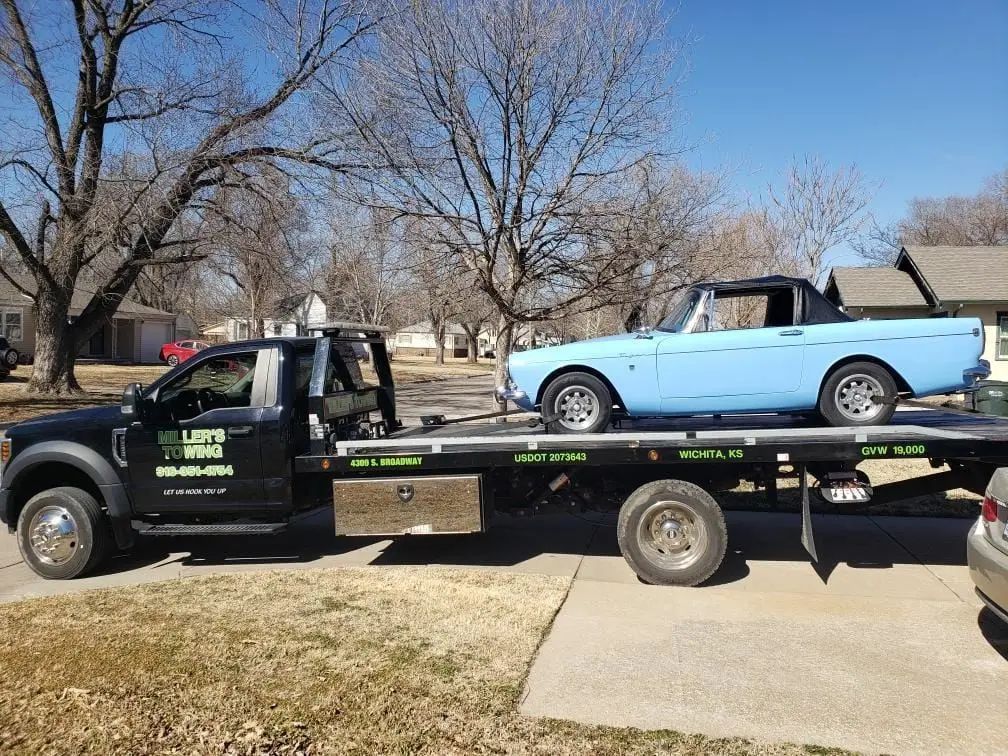
Towing a lowered car without scraping it comes down to one thing: the loading angle. A flatbed tilts to form a ramp. If the ramp is too steep, the front bumper or splitter touches before the tires do. A careful driver makes that angle shallower with blocks, the slope of the ground and a slow winch.
If your car sits low, say so when you call. Miller’s Towing & Recovery is at 316-351-4754. Tell the dispatcher how low it is and what hangs lowest, and we will send a flatbed set up for it.
Why Low Cars Scrape on a Tow Truck
Three things on a low car touch first:
- The front lip, splitter or air dam. It reaches the ramp before the front tires start to climb.
- The middle of the car. At the top of the ramp, where the deck levels out, a long low car can high center on the exhaust or the frame rails.
- The rear bumper or diffuser. It drags as the back tires come up onto the deck.
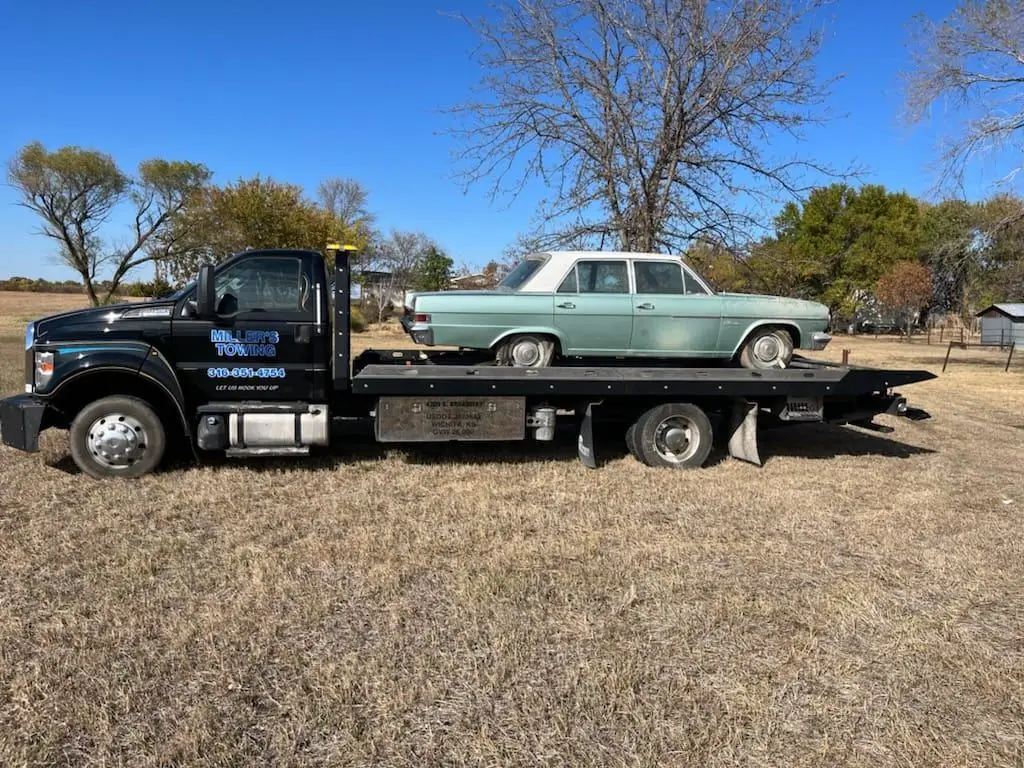
A wheel lift truck has its own problem. The crossbar has to slide under the bumper to reach the tires, and on a low car there is no room. That is why a lowered car belongs on a flatbed.
Towing a Lowered Car: 6 Ways to Keep It From Scraping
1. Start with a flatbed and lower the deck all the way
The farther the bed slides back and down, the shallower the ramp. The driver should bring the tail of the bed fully to the ground before the car moves an inch.
2. Use the ground
Where the truck parks changes the angle. If the back of the bed sits in a low spot, like a gutter or the bottom of a sloped driveway, and the car sits on higher ground, the ramp gets flatter. A driver who walks the area before backing in is doing it right.
3. Add blocks or ramps
Wood blocks or low ramps placed at the foot of the bed lift the front tires early, so the nose rises before it reaches the steel. The same trick works at the top of the bed to keep the middle of the car from touching.
4. Raise the car if it can be raised
Air suspension and nose lift systems exist for this. Tesla’s instructions for transporters tell operators to set the air suspension to its highest setting and turn on Jack Mode before the car is loaded, because the system keeps trying to level itself even with the power off. If your car has air ride, raise it and lock it before the truck arrives.
5. Winch slowly with someone watching the nose
A low car should be pulled up with the winch, not driven up. One person runs the winch and watches the cable. A second set of eyes at the front bumper calls a stop the moment clearance gets tight. The cable hooks to the factory tow eye, not to a control arm or a tie rod.
6. Strap the wheels, not the body
Once the car is on the deck, it is held at the tires with straps or wheel nets. Tesla’s manual says the same about its own cars: tie down at the wheels, keep metal parts off painted surfaces and wheel faces, and do not put straps over body panels. Hooks on suspension parts can bend them, and on a low car there is little room to reach them anyway.
What to Tell Dispatch
Towing a lowered car goes faster when the driver knows what to expect before leaving the yard. Share these details on the first call.
| Detail | Why it matters |
|---|---|
| How low the car sits, in inches if you know | Decides how many blocks and how much setup time |
| What hangs lowest: lip, splitter, side skirts, exhaust | Tells the driver where to watch |
| Coilovers, lowering springs or air ride | Air ride can be raised. Static cars cannot |
| Wide wheels or heavy camber | Affects which straps fit |
| Where the tow eye is | Many cars keep a screw in tow hook with the spare tire tools |
| If the car runs, rolls and steers | A car that does not roll needs skates |
| All wheel drive or not | All wheel drive must have all four wheels off the road |
A photo of the car from the side, sent by text, answers most of these at once.
Find the Tow Eye Before You Need It
Most modern cars have a threaded socket behind a small cover in the front bumper. The tow eye screws into it. It is usually stored with the jack or the spare tire tools. On many European cars the thread is left handed, so it tightens the opposite way. Find yours now and keep it where you can reach it. It gives the winch a strong, straight pull without touching the bumper.
Where Low Cars Get Into Trouble Around Wichita
- Steep driveway aprons and parking lot entrances. A car that scrapes pulling in can also get stuck there.
- Speed bumps and parking blocks. A cracked oil pan or a torn bumper cover ends the drive.
- Railroad crossings and rough pavement. A hard hit can bend a wheel or break a suspension part.
- Car shows and cruise nights. Show cars that do not run well in traffic are often moved on a flatbed both ways.
- Winter. Packed snow in a parking lot is taller than the clearance on a lowered car.
For a planned move to a show, a shop or storage, book ahead. See how to schedule a tow in Wichita.
Questions About Towing a Lowered Car
Can you tow a lowered car at all?
Yes. It goes on a flatbed with blocks or ramps to flatten the angle. Very low cars take longer to load, so allow extra time.
What are the challenges of towing a lowered car?
The loading angle, the lack of room for hooks and straps, and low parts like splitters and exhaust tips. Each has an answer: a flatter ramp, wheel straps and a slow winch.
Can a lowered car go on a wheel lift truck?
It is a poor fit. The lift bar has to pass under the bumper, and the car rides nose up or tail up with the other end close to the pavement.
Does towing a lowered car cost more?
It can, because the setup takes more time. Describe the car when you call and ask for the total before the truck is sent.
What if my car was scraped during a tow?
Take photos before it moves again and report it in writing. Our guide on what to do when a tow truck damaged your car has the steps.
My low car is also all wheel drive. Does that change anything?
It is one more reason for a flatbed. See can you tow an AWD car.
Need a Low Car Moved in Wichita?
Towing a lowered car is slow work done right. Call Miller’s Towing & Recovery at 316-351-4754 and describe the car. We offer flatbed towing across the city as part of our towing services in Wichita, KS, and you get the price before we hook up.