If you hit a deer in Kansas, pull onto the shoulder, turn on your hazard lights, and call for help before you do anything else. Then check two things: is anyone hurt, and is the car safe to drive? This guide walks through each step, the Kansas reporting rule, how insurance treats a deer strike, and the signs that mean your car needs a tow.
Miller’s Towing & Recovery works out of 4309 S Broadway in Wichita. We pick up deer damaged cars all fall, so the steps below come from what we see on real calls.
How Common Are Deer Crashes in Kansas?
They are very common. Drivers hit a deer in Kansas more than 10,000 times in 2024, by the Kansas Department of Transportation’s count, and more than 51,000 since 2020. Deer were part of 39 percent of all single vehicle crashes in the state that year. Five people died and 674 were hurt, according to KDOT figures reported by KWCH 12 News.
November is the worst month. The Kansas Department of Wildlife and Parks says the deer breeding season, called the rut, peaks in the middle of November. Deer move more, pay less attention to cars, and are most active at dawn and dusk. That is the same time most of Wichita is driving to or from work.
KDWP also notes that counties with more people and more traffic record the most deer crashes. Sedgwick County fits that description. Around Wichita, the risk is highest where roads run past water, trees, and open ground. Think of K-96 near Chisholm Creek Park, the roads along the Arkansas River and the Big Ditch, K-254 heading to El Dorado, and West Kellogg on the way to Goddard.
What to Do Right After You Hit a Deer in Kansas
Follow these seven steps in order.
- Slow down and pull over. Get as far onto the shoulder as you can and turn on your hazard lights.
- Check everyone in the car. If anyone is hurt, call 911 first.
- Call for help. On a Kansas highway, dial *47 for the Kansas Highway Patrol. On the Kansas Turnpike, dial *582 (*KTA). Inside Wichita, call 911.
- Stay in the car with your seat belt on. KDWP says you are better protected inside the vehicle than standing on the shoulder if another driver hits your car.
- Leave the deer alone. A hurt deer can kick hard. If it is lying in the road, tell the dispatcher. Troopers or local officers will handle it.
- Take photos. Get the damage, the road, the deer if you can see it safely, and any fur or blood on the car. Your insurance company will want them.
- Decide if the car is safe to drive. Use the checklist in the next section. If you are not sure, call a tow truck.
One more rule. The KDWP wildlife crash page says drivers in a crash with no injuries on an interstate, a U.S. highway, or any divided or multi lane road should move the vehicle out of the traffic lane if it can be moved. On Kellogg, I-135, or I-235, that means the shoulder or the next exit ramp.
Do You Have to Report It?
Sometimes. When you hit a deer in Kansas, state law requires you to report the crash right away to the nearest law enforcement agency if someone is hurt or if the property damage adds up to $1,000 or more. KDWP states that failing to report a crash is a misdemeanor and can lead to a suspended license.
A thousand dollars is not much body work. A cracked bumper cover, a headlight, and a bent hood will pass that number on almost any newer car. If you are in doubt, report it. You will also want the report number for your insurance claim.
Can you keep the deer?
Only with a salvage tag. Kansas requires a salvage tag to remove a deer carcass, or any part of it, from a crash site. KHP troopers, sheriff’s deputies, and KDWP game wardens can issue one. Ask the officer who comes to the scene.
Is Your Car Safe to Drive After a Deer Strike?
A deer weighs enough to break parts you cannot see from the driver’s seat. Walk around the car, if it is safe to get out, and look for these problems.
| What you see | What it can mean | Drive or tow? |
|---|---|---|
| Green, orange, or pink fluid under the front | Radiator or coolant hose is leaking | Tow. The engine can overheat in a few miles. |
| Steam or a sweet smell | Coolant on a hot engine | Tow |
| Hood will not latch | Latch or support is bent | Tow. The hood can fly up at speed. |
| Airbags went off | Safety system has fired | Tow |
| Headlight or turn signal is out | Not legal or safe after dark | Tow at night |
| Tire rubs the fender or the wheel pulls | Bent fender, wheel, or suspension | Tow |
| Only a small dent, no leaks, lights work | Cosmetic damage | Drive slowly to a shop and watch the temperature gauge |
The radiator is the part people miss. It sits right behind the grille, which is where most deer hit. The car may start and drive fine for a few minutes, then overheat on the way home. If you see any fluid at all, do not drive it.
When You Need a Tow in the Wichita Area
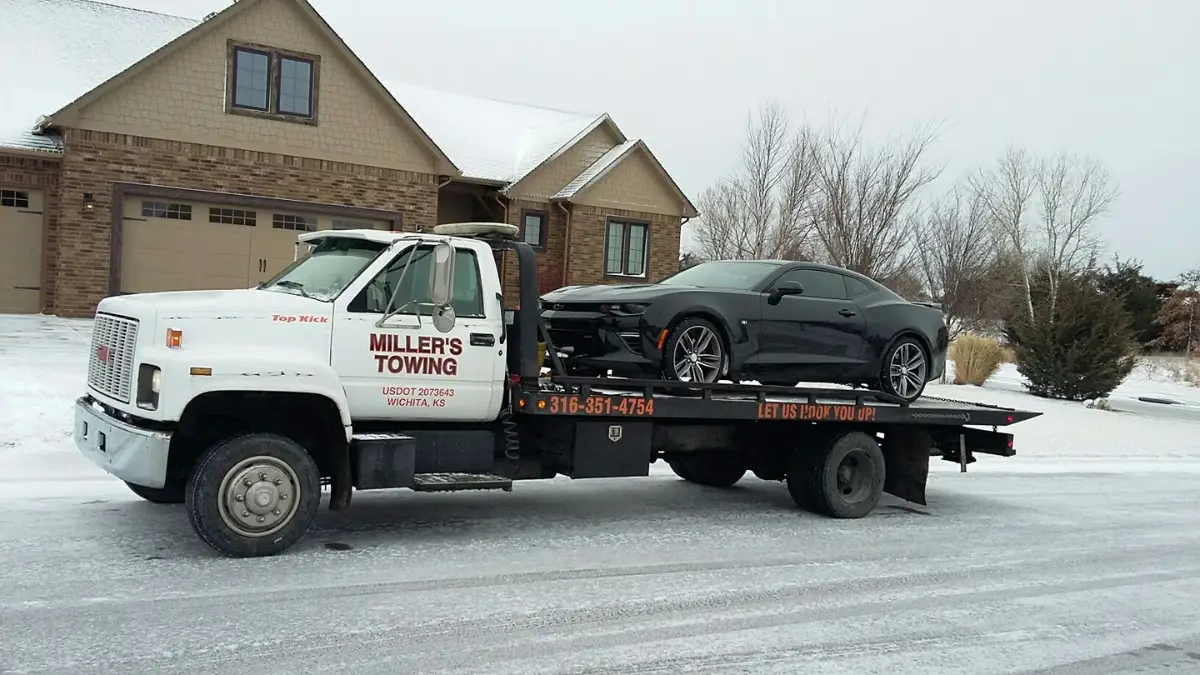
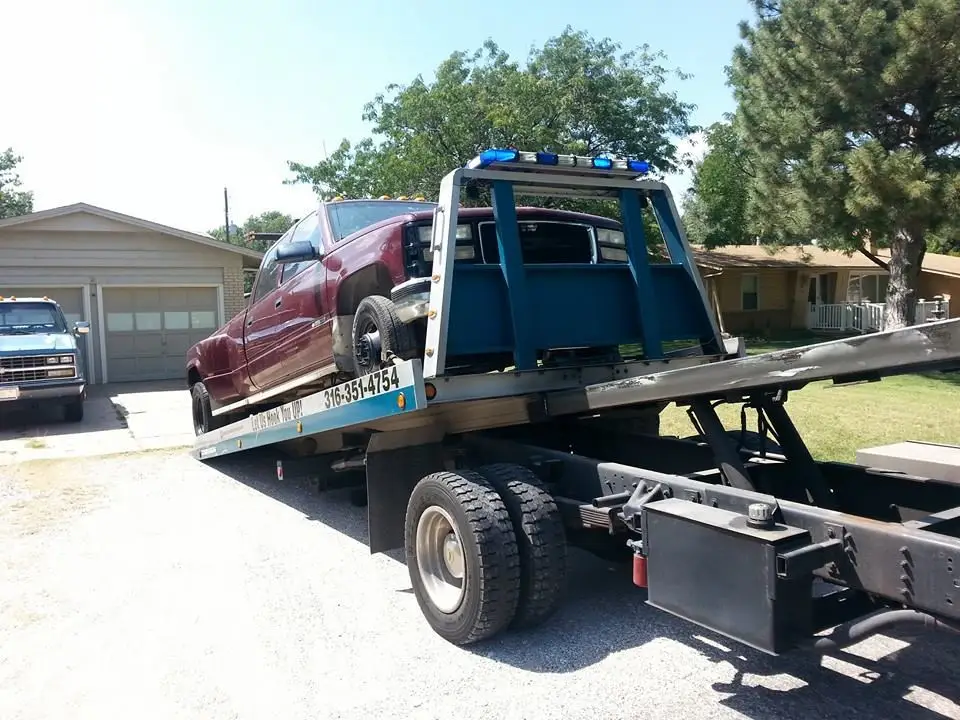
Call for a tow if the car fails any check in the table, if you are shaken up, or if it is dark and a headlight is out. Our auto recovery service covers crash damaged cars that cannot roll or steer. We usually load them on a flatbed so all four wheels are off the ground. You can read more about that on our flatbed towing page.
When you call, tell the dispatcher:
- The road, direction, and nearest mile marker or cross street
- The year, make, and model of the car
- What is damaged and if the wheels turn
- Where you want the car to go: a body shop, your home, or our yard on South Broadway
You get a price before we hook up. If the crash was inside Wichita city limits and police are at the scene, you can ask the officer for the tow company you want. Our guide on what to do after a car accident in Wichita covers the rest of that process.
Does Insurance Pay When You Hit a Deer in Kansas?
In most cases, yes, if you carry comprehensive coverage. Insurers usually treat a deer strike as a comprehensive claim, not a collision claim. You pay your comprehensive deductible and the policy pays the rest of the covered repair. A liability only policy does not pay for damage to your own car.
There is one catch. If you swerve to miss the deer and hit a guardrail, a ditch, or another car, most insurers handle that as a collision claim. That is one more reason KDWP tells drivers not to swerve. Brake hard and stay in your lane.
Many policies with roadside or towing coverage also pay for the tow. Ask your agent, and keep the tow receipt. Policies differ, so check your own before you count on it.
Questions Drivers Ask After They Hit a Deer in Kansas
Do you call the police if you hit a deer in Kansas?
Call if anyone is hurt, if the deer or your car is blocking the road, or if the damage looks like $1,000 or more. In Wichita call 911. On state highways dial *47, and on the Turnpike dial *582.
Do you need a police report for insurance?
Kansas law does not require one for every claim, but most insurance companies ask for it. A report number and photos make the claim faster.
Do you pay a deductible when you hit a deer?
Usually yes. A deer claim normally falls under comprehensive coverage, and your comprehensive deductible applies.
Should you replace a child car seat?
Check the seat maker’s instructions. Many makers say to replace a car seat after a moderate or severe crash, and some insurers pay for it.
What time of day are deer crashes most likely?
Dawn and dusk. KDWP says deer are most active then, and fall days put those hours right in the morning and evening commute.
Need a Tow After a Deer Strike?
If you hit a deer in Kansas near Wichita, Derby, Haysville, Park City, or Andover and the car should not be driven, call Miller’s Towing & Recovery at 316-351-4754. We answer day and night. You can also see our full list of towing services in Wichita, KS or reach us through the contact page.